

Meet the owner
Andreas Liebenberg
Andreas has owned Bateleur since 1991 and has shaped every part of it, from the design of the camp to guiding guests on specialist itineraries. With over 20 years in conservation and a background in tracking and anti-poaching, he has twice received the Timbavati Private Nature Reserve’s conservation award for the most eco-sensitive landowner.
A Truly Rare Sighting: A Leucistic Hornbill in the Timbavati
The African bushveld is full of surprises, and now and then, it presents us with something truly unusual. In early November, on the southern boundary of the Bateleur property in the captivating Timbavati Private Nature Reserve, we were fortunate enough to encounter a particularly rare and interesting bird: a leucistic red-billed hornbill.
So what’s all the fuss about? Even casual birdwatchers know that red-billed hornbills are a pretty common sight in South Africa’s Lowveld. But this specific individual was far from ordinary. Its highly unusual plumage made it stand out from the birds we regularly encounter and provided a fascinating glimpse into one of nature’s lesser-known genetic variations.
Leucism is a genetic condition that occurs when pigment-producing cells (melanocytes) fail to develop properly or distribute pigment normally, resulting in a partial or complete reduction of pigmentation in the feathers. In particular, the distribution of melanin, the pigment responsible for many of the darker colours in birds’ plumage, is affected, causing some or all of the feathers to appear white. The condition can be partial, where only certain feathers or patches are white, or it can be complete, where the bird has an almost entirely white appearance.
It is important not to confuse leucism with albinism. An albino bird completely lacks the ability to produce melanin, affecting not only its feathers but also its eyes, beak, and legs. Typically, it has a pale beak, pink or reddish eyes, impaired vision, and poor eyesight. A leucistic bird, on the other hand, generally retains normal eye colour (dark irises), as well as normal vision. Its beak and legs may also retain their usual colour, which was the case with the bird we spotted in the Timbavati.
Although leucism has been recorded in numerous bird species around the world, it remains a very unusual occurrence in wild populations. The frequency varies considerably between species and populations, and there is no reliable universal figure for how many leucistic birds exist. In most wild populations, however, individuals displaying these unusual colour variations represent a very small percentage of the total. We’re talking way below 1%, which makes the sighting of a leucistic bird in the wild something to savour, even if you’re not an obsessive twitcher.
While an unusual white appearance might make a bird particularly attractive to us, it can present some real challenges in the wild. The most obvious disadvantage is camouflage. Birds rely heavily on their natural colouring to blend into their surroundings, avoid predators, and, in some cases, approach their prey unnoticed. A predominantly white bird living in the African bushveld may be considerably more conspicuous against the natural browns and greens of its environment, potentially making it far easier for predators to spot.
There may also be disadvantages when it comes to feather durability. Melanin contributes to the strength and resistance of feathers, particularly against wear and abrasion. Feathers lacking normal pigmentation may therefore be more vulnerable over time to damage and degradation.
Unusual colouring can also potentially influence social interactions and mate selection, although the extent to which this affects individual birds varies between species.
It is worth remembering that leucistic birds are not necessarily unhealthy or unable to survive in the wild. Unlike true albino birds, they generally have normal eyesight, and many can live perfectly functional lives.
Our sighting of this highly unusual, red-billed hornbill was a wonderful reminder of just how diverse and fascinating the natural world can be. In a reserve as rich in biodiversity as the Timbavati, there is always something new to discover. Sometimes, it is not the largest animal or the most dramatic encounter that makes a game drive memorable, but rather a small, unexpected reminder that nature never ceases to surprise us.
Recent sightings
The first week of November was an interesting one for casual birdwatchers and twitchers alike. In addition to the leucistic red-billed hornbill, the Bateleur guests were treated to sightings of Southern Ground Hornbills, Martial Eagles, a white-headed vulture, a red-crested korhaan performing its dramatic, multi-stage courtship display, and, during a bush walk, a memorable discovery of a female ostrich guarding her nest of 12 eggs.
Black mambas, honey badgers, a family of jackals, and an African wildcat were all spotted on the hunt for small mammals and birds, while the hyenas were frequently seen on the prowl for larger plains game. We had the pleasure of encountering a clan of 9 hyenas at Rockfig Pan and enjoyed a walk-by from a lone hyena just after we had all boarded the game-viewing vehicle after one of the sunset drinks stops.
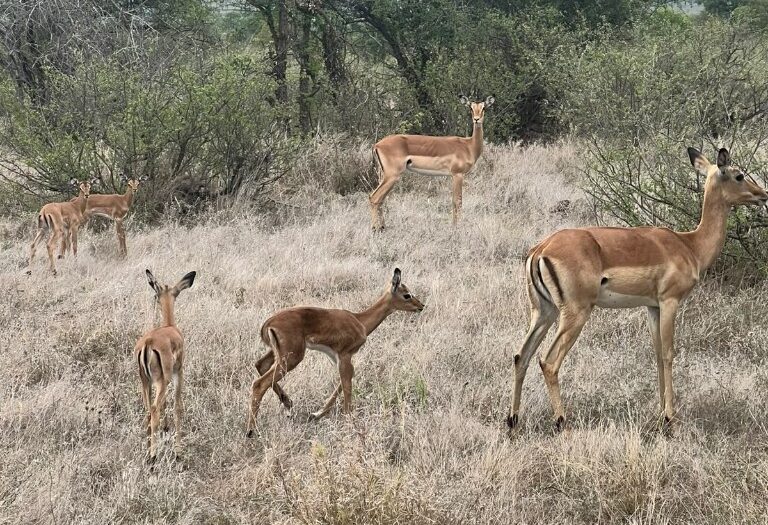
The African wild dogs are back in the Timbavati, and, over a couple of days, we enjoyed a few quality sightings of them in the same area. They will be alert to the presence of multiple baby impala that have been born over the last few weeks, delicate little beauties that we encountered daily throughout the reserve. The newborns will have also piqued the interest of the leopards; the spotted big cats gave our guests five different enthralling sightings during the week, including a female with her adult impala kill.
Given all the mouths they have to feed, the lion prides are more interested in the larger plains game, especially the meaty zebras and the hefty buffalo. On a couple of occasions, we encountered a big breeding herd of buffalo and a separate group of 5 dagga boys, ideal specimens for the many tawny big cats of the Timbavati.
Early in the week, we picked up the tracks of the Mayambula pride and located the lions close to Bateleur’s southern boundary. We saw the pride again at the end of the week, relaxing at Nyala Pan in the morning and then moving north during the afternoon, a wonderful start to their safari for our new guest arrivals.
The full Sark Breakaway Pride, including their 7 cubs, was discovered on a zebra kill only a few kilometres from camp. And our guests were also treated to sightings of 3 beautiful lionesses at Impala Dam one morning, and a big lone male on the prowl just before dusk one afternoon.
The rhino highlights for the week included a mother and her baby, 2 bulls engaged in a territorial fight, and a lone rhino hanging out with a herd of elephants that were digging for water in a dry riverbed. That was one of many encounters that we had with herds of elephants during the week, complemented by quality time spent with big elephant bulls at Marcos Dam and Impala Dam. We really are truly blessed with the incredible sightings that we frequently have of these giant pachyderms in the Timbavati reserve!
The hot weather that we experienced for most of the first week of November gave way to cooler, cloudy and wet conditions on Sunday. This is consistent with the transition into the summer rainy season, and it won’t be long until the baby impalas’ playground transforms from yellowish-brown to multiple shades of green, providing more and more places to hide.
Breathe Africa – Bateleur Safari Camp.